The two regions, Balochistan and Gilgit-Baltistan, were folded into Pakistani state by force and illegality in 1947. Since then, Pakistan has been finding it difficult to control these regions. Instead of offering democratic and developmental atmosphere, Pakistan has been using repression as a tool to exert State control. This is proving to be counter-productive as the fresh round of intense protests reveal.
Once again, Pakistan opened fire on the people of the occupied regions. An AFP tally put the dead at around 20 within days, while local accounts ran higher. International organisations flagged the extrajudicial killing that triggered it. The Internet was cut, the committee's offices sealed, and paramilitary troops came in. To understand why the people of these two regions are often in clash with the Pakistani establishment, one must take a look at history.
1947-1948: How The Two Regions Were Forced
When the British left the Indian sub-continent in 1947, the princely state of Kalat, the heart of the Baloch country briefly declared itself independent on 15th August.
Scholar-author Tilak Devasher, in his phenomenal book ‘Pakistan: The Balochistan Conundrum’, traces the deep Baloch sense of grievance to what happened next. For roughly seven months, the State of Kalat governed itself. Its newly elected Lower House even rejected any kind of merger with Pakistan. Then, in late March 1948, when the Pakistan Army moved into Kalat and the Khan of Kalat was pressed to sign the instrument of accession, the Kalat state ended.
Pro-Pakistani state historians call it a voluntary, pragmatic choice but Baloch nationalists, the indigenous people of the region, call it ‘annexation at gunpoint’. The dispute has never been settled and it remains the founding wound of the conflict.
The northern region’s story ran differently but ended in the same place. In November 1947, a local uprising in Gilgit region, led by radical elements of the British-raised Gilgit Scouts, detached the region from Hari Singh, the Maharaja of Jammu and Kashmir, and offered it to Pakistan.
Pakistan quickly took over control illegally but did not grant the territory provincial status or any constitutional rights. Gilgit-Baltistan was governed for decades through Islamabad-appointed officials under a frontier framework, a region administered but never enfranchised. This issue of disenfranchisement persists even today.
Negotiation as Pak’s Trap: The Roots of Baloch Distrust
Two early episodes hardened Baloch distrust of the Pakistani state. In 1948, the Khan of Kalat's brother, Prince Abdul Karim, rose in revolt. He was reportedly invited to talks and dinner by a senior army commander but was arrested on arrival. A decade later a similar act was repeated more cruelly.
Pakistan’s One Unit scheme stripped federalism and autonomy to govern separate provinces across the country. Baloch autonomy was also stripped and the elderly tribal leader Nawab Nauroz Khan revolted and went to the hills in 1958. The Pakistani authorities induced him to come down by swearing an oath on the Quran that his demands would be heard and his men would be spared. He surrendered.
Khan and scores of followers were instead arrested and in 1960, five of his sons and companions were hanged, while he died in jail. For generations of Baloch, ‘negotiation’ became a word fraught with betrayal.
Gilgit 1988: An anti-Shia Massacre
Gilgit-Baltistan's major trauma came in May 1988. A sectarian dispute that started over the sighting of the Eid moon escalated. Under Pakistan’s then military dictator General Zia-ul-Haq, the State’s response was not to restore order. Rather than deploying the regular army, a young Brigadier Pervez Musharraf was deputed. Armed Sunni militants from the frontier and Afghanistan, including Osama bin Laden, author of 9/11 attack in the US, was sent into the Shia-majority valleys.
Several hundred Shia civilians were slaughtered over days of arson and killings. This episode shows how state policy was amalgamated with sectarian radicalism in a way the region has never recovered from. Evidence of this can be seen in anti-Shia attacks all over Pakistan.
Engineering the Demography of the North
Alongside violence, Pakistan ran a quieter policy of demographic change. Gilgit-Baltistan's historic ‘State Subject Rule’, which was inherited from the princely era, barred outsiders from buying land or settling, thus protecting the local, largely Shia population.
In 1974, the Pakistani state abolished that rule. Combined with the opening of the Karakoram Highway to China, the Pakistani establishment promoted sustained settlement by Sunnis from Punjab and Khyber Pakhtunkhwa in Gilgit-Baltistan. Researchers and rights advocates estimate that the Shia share of the population fell from around 80 per cent in 1948 to roughly 39 per cent today, making Shia a de facto minority.
A community that was a clear majority at accession is now a minority at best. This outcome is not an accident but a deliberate dilution of the region's identity by engineering the demography.
Bugti, 2006: Killing the Man You Are Talking To
The single act that reignited the modern Baloch rebellion was the death of Nawab Akbar Bugti, former Governor and Chief Minister of Balochistan, who was killed in cold blood in an army operation in August 2006. The operation was ordered by Pakistani Military dictator Pervez Musharraf.
By multiple accounts, including the figures sent to mediate, Bugti was willing to negotiate. A senator on the negotiation team later said the establishment's (Pakistani Army) mindset, not Bugti's, blocked a negotiation which would lead to peace. The Pakistani armed forces carried out months of bombing around Dera Bugti, home to the Baloch leader Akbar Bugti and his Bugti tribe displacing an estimated 1,60,000 people before he was killed in a cave at the age of 79. A court later acquitted Musharraf of involvement. But, in Baloch memory, the message was deeply imprinted that even a former Chief Minister and someone who co-operated with the Pakistani state could be hunted down and killed mercilessly. The insurgency has not paused since.
The Last Decade: Disappearances, Graves, and a Crushed Civic Movement
What distinguishes the present phase of the Baloch rebellion is not the violence of the rebels but the scale and method and the barbarity of the state's response. Enforced disappearance which is abduction by Pakistani armed security forces followed by indefinite, unacknowledged detention has become, an instrument of state policy rather than an aberration.
Bodies later surface by roadsides or in unmarked mass graves. In January 2014, villagers near Tootak in Khuzdar district of Balochistan uncovered unmarked graves. Locals’ and rights bodies’ estimates of the dead ranged from well over a hundred to thousands and no credible investigation by law enforcement followed.
Such graves for the Baloch have become a sign of the disappearance system. The pain of the Baloch people is such that even a young educated Shari Baloch became a suicide bomber after having a dual masters degree in Zoology and Philosophy. The Baloch rebellion especially by the young is a direct result of the establishment’s barbarity.
Such large numbers point in one direction. Pakistan's own Commission of Inquiry on Enforced Disappearances logged roughly 3,000 missing-person cases from Balochistan since 2011. Independent monitors recorded hundreds of disappearances and killings in 2023 and in 2024, with the toll rising rather than falling. Amidst the state barbarity and the rebellion against it, a new generation built a peaceful answer.
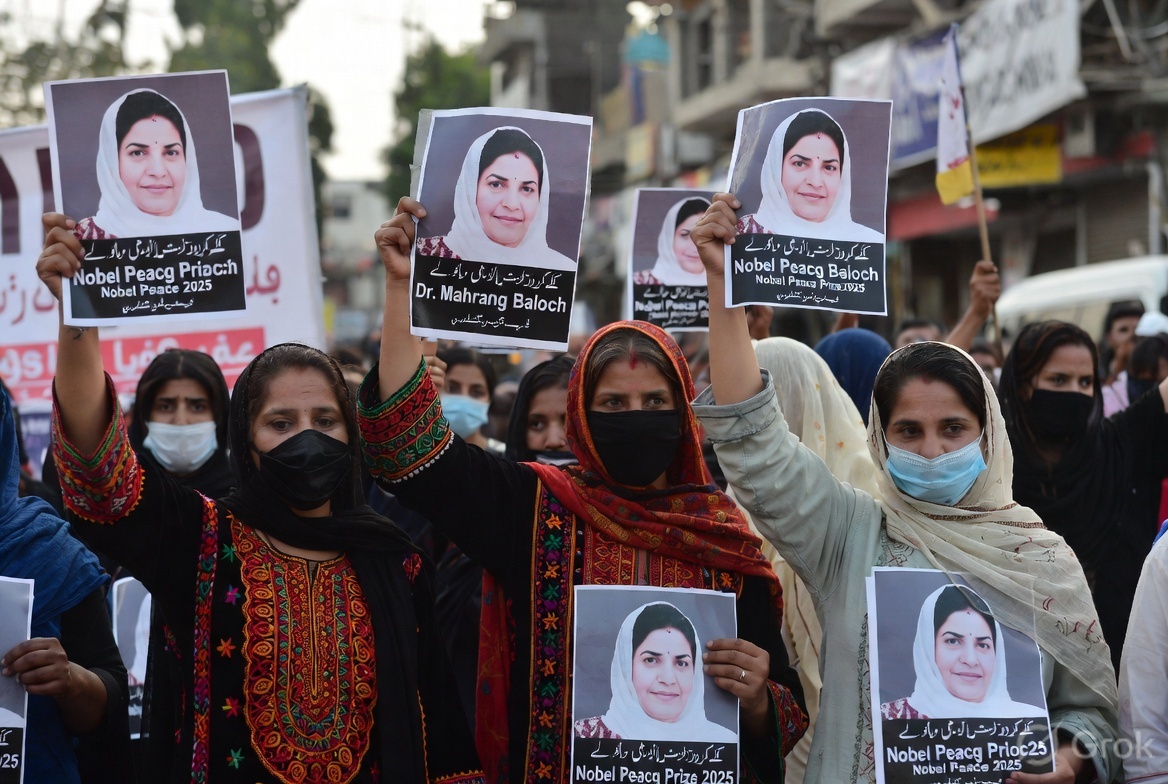
The Baloch Yakjehti Committee (BYC), founded in 2020 and led largely by young women, organised long marches and sit-ins demanding only that the disappeared families be produced before a court. The Pakistani state's reply? Prosecution, not dialogue.
In March 2025, after a train hijacking by rebels, the inhumane crackdown by the Pakistani establishment widened. Dr Mahrang Baloch, a young physician honoured by ‘Time’ and the ‘BBC’ was arrested on contested charges of terrorism and sedition. Police fired on a protest outside Quetta's university, killing three.
More than a year on, she remains imprisoned. Her case is a test of whether civic, constitutional, democratic protest has any space left in the province or in the entire Pakistan. From her cell, Dr Mahrang Baloch reported that the committee had documented over 1,200 disappearances in 2025 alone. Even Dr Mahrang Baloch’s lawyer Imaan Zainab Mazari-Hazir, a Shia and daughter of a former Pakistani minister Shireen Mazari, was sentenced to 17 years of imprisonment on flimsy charges under the Prevention of Electronic Crimes Act (PECA).
Pak Follows The Same Script in Gilgit-Baltistan
Pakistan has been following the same script in the northern region.
Across 2024 and 2025, the Jammu Kashmir JAAC members protesting electricity prices, flour costs, economic disparity and the privileges of the political and establishment elite was answered with live fire rather than negotiations.
At least five died in the 2024 long march and roughly 20 more across the September-October 2025 shutdowns. Several of them were shot at close quarters. The most revealing moment came in June 2026.
Days before a planned rally, the regional administration of Gilgit-Baltistan which is selected by the Pakistani establishment, declared the JAAC a proscribed ‘terrorist’ organisation under anti-terror law. This was viewed as turning the legislation for armed militants against an unarmed civic movement with economic and constitutional demands.
The designation says a lot. It criminalises the act of democratic protest and lets the state detain organisers, freeze the committee's offices and shut down mobile internet without having the inconvenience of ordinary due process. When mourners gathered peacefully in Rawalakot in Poonch district around the body of a slain activist, security forces opened fire on them. An AFP tally counted around 20 dead within days, with local figures running higher. Amnesty International called for an independent inquiry into what it described as an extrajudicial killing and the unlawful deaths of peaceful protesters. The region was locked down ahead of a July election.
The Pakistani ledger on human rights violations and barbarity is consistent across seven decades in many regions like Balochistan, North West Frontier Province (now Khyber Pakhtunkhwa) and Gilgit-Baltistan. Forceful invasion and merger into the Pakistani state, promises offered and broken, demographic and sectarian engineering and a security doctrine that treats even peaceful dissent as something worthy of disappearance rather than redressal.
The rebellion in Pakistan may be sustained by a minority but the alienation that feeds it is far broader. As some scholars argue from inside Pakistan, it is rooted less in foreign conspiracy than in the state's own choices of authoritarian, centralised control.

No comments yet. Be the first to share your thoughts!