Local folklore tells the story of two rivers born in the same hills but destined to live separate lives. The Narmada and the Son both rise in the forests of Amarkantak in Madhya Pradesh's Maikal hills. Yet the Narmada flows westward across central India to meet the Arabian Sea, the Son turns east and eventually joins the Ganga. For centuries, the two rivers have belonged to different worlds.
Deep beneath the Vindhya hills near Sleemanabad in Katni district, engineers are about to change that story.
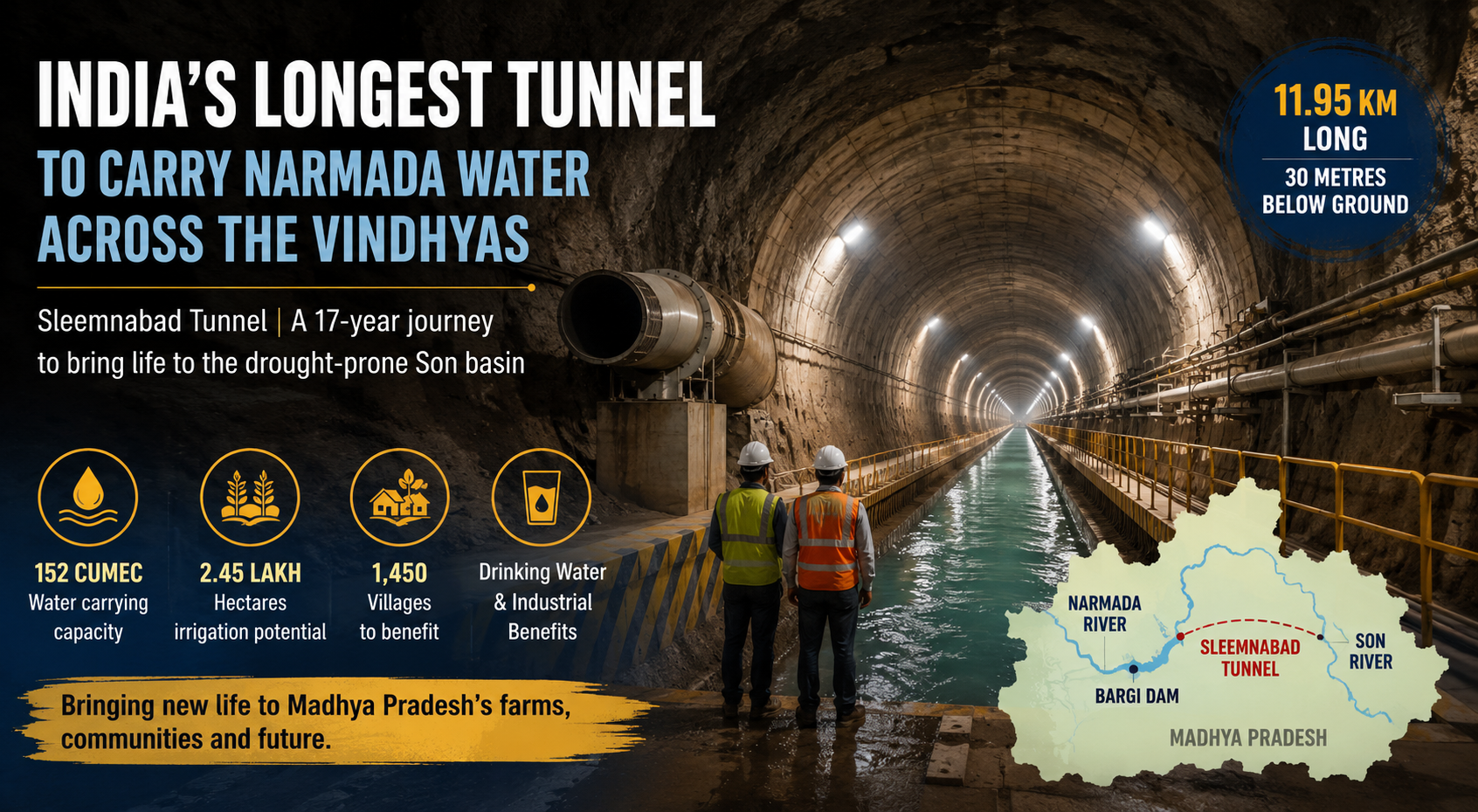
After 17 years of construction, India’s longest irrigation tunnel is nearing completion. The 11.95 kilometre-long tunnel will carry Narmada water from the Bargi Dam basin beneath the Vindhya ridge and into the Son basin for the first time. What sounds like a simple transfer of water is actually one of the most ambitious and challenging irrigation projects ever undertaken in MP.
The tunnel forms the heart of the Bargi Diversion Project and is expected to irrigate nearly 2.45 lakh hectares of farmland across Katni, Satna, Maihar, Rewa and Panna districts. Around 1,450 villages will benefit from the project.
For a region that has long depended on uncertain monsoons, the tunnel promises something more valuable than infrastructure: certainty.
A vision born with Bargi dam
The idea behind the project is much older than the tunnel itself.
When the Bargi Dam, officially known as the Rani Avanti Bai Sagar Project, was planned and built on the Narmada River during the 1970s and 1980s, engineers noticed a striking contrast. While the Narmada basin had abundant water resources, large parts of the Vindhya region regularly struggled with drought and water scarcity.
The solution appeared simple on paper: divert a portion of Narmada water across the Vindhya hills and bring assured irrigation to the dry districts lying in the Son basin. But, the challenge was geography.
Between the Bargi reservoir and the proposed command area stood the rocky Vindhya ridge around Sleemanabad. Engineers initially considered constructing an open canal, but the idea was soon dropped. Such a canal would have required extensive excavation through hills, settlements, highways and railway lines. The cost, environmental impact and safety concerns made the proposal impractical.
The answer was to go underground.
Massive scale, unpredictable terrain
Stretching 11.95 kilometres, it is recognised as India’s longest irrigation tunnel. It runs nearly 30 metres below the surface and has an internal diameter of about 10 metres. Engineers have designed it to carry 152 cubic metres of water every second, allowing enormous quantities of Narmada water to cross from one river basin to another.
Once operational, the project will provide assured irrigation to nearly 2.45 lakh hectares of farmland. It is expected to benefit around 1,450 villages spread across Katni, Satna, Maihar, Rewa and Panna districts. Beyond agriculture, it will strengthen drinking water supplies and support future industrial growth in cities such as Jabalpur and Katni.
Construction was formally awarded in March 2008 to a joint venture company. Officials initially expected the tunnel to be completed by 2011. Very quickly, however, engineers realised that the conditions beneath the Vindhya hills were far more difficult than anticipated.
Before excavation began, geological investigations included the drilling of 12 boreholes. As excavation progressed, workers encountered constantly changing geology. In some sections there was hard marble. In others, soft limestone filled with cavities and voids. Sometimes one side of the tunnel boring machine would be cutting through solid rock while the other side entered empty spaces. These sudden transitions repeatedly damaged equipment and slowed progress.
The deeper engineers went, the more unpredictable the terrain became.
The battle against water
If the geology was difficult, groundwater proved even more challenging. Engineers initially expected groundwater to be encountered at depths of six to eight metres. Instead, they discovered water-bearing zones much deeper, often between 12 and 16 metres.
Large quantities of water continuously entered the tunnel through cracks and cavities in the rock. At times, inflow rates reached between 18,000 and 20,000 litres per minute. Workers frequently found themselves operating in knee-deep and waist-deep water. In some stretches, reaching pumping stations required moving through flooded passages.
To keep construction moving, high-capacity pumping systems with nearly 4,000 horsepower of installed capacity had to operate continuously. Backup diesel generators remained on standby because even a short interruption could allow water levels to rise rapidly.
More than Rs 100 crore has reportedly been spent on dewatering operations alone.
The Machine That Got Trapped
Excavation initially relied on a giant American-made Robbins Tunnel Boring Machine (TBM). The machine was more than 130 metres long and featured a cutting head nearly 10 metres in diameter. It was expected to be the key to rapid construction.
Instead, the Vindhyas fought back. The mixed geology and relentless groundwater repeatedly damaged the machine. Cutters wore out rapidly, maintenance became frequent and progress slowed dramatically. The biggest setback came in 2013 when a large sinkhole formed above the tunnel alignment. The incident trapped the TBM underground and effectively halted progress for almost a year.
By 2016, the future of the project appeared uncertain.
The 130 crore rescue plan
To save the project, the Madhya Pradesh government approved the import of a new German-made Herrenknecht Tunnel Boring Machine worth around Rs 130 crore. The new machine began excavation from the upstream side while the original machine continued working where possible from the downstream end.
For the first time, excavation proceeded simultaneously from both directions. Together, the two machines excavated nearly the entire tunnel length and slowly advanced towards each other beneath the Vindhya hills.
The challenges underground inevitably affected the project’s finances. The original estimate for the tunnel stood at around Rs. 799 crore. Today, the cost has nearly doubled to approximately Rs. 1,600 crore. Several factors contributed to the cost escalation.
Geological surprises required additional engineering measures. Continuous pumping operations consumed large sums of money. Engineers also had to stabilise weak geological sections through extensive grouting. High-grade cement was injected into underground cavities and fractured limestone formations to strengthen the rock and prevent collapse.
Every metre of progress came at a price.
The human cost
Behind the machines and engineering records lies another story.
For years, teams of around 50 to 60 workers operated around the clock in three shifts. They travelled through the tunnel using small locomotive systems and spent long hours in darkness, waterlogged conditions and confined spaces.
The project also carried a human cost. Reports indicate that two workers lost their lives in tunnel collapses while another died following a snake bite near the construction site. Several others suffered injuries during the long years of construction.
Why the project survived
Many infrastructure projects facing such difficulties would have been abandoned. The Sleemanabad Tunnel survived because governments, engineers and planners remained committed to completing it despite repeated setbacks.
As deadlines slipped and costs increased, the project received multiple extensions. Yet funding continued. A significant part of this continuity came during the tenure of former Chief Minister Shivraj Singh Chouhan. His government continued supporting the project during some of its most difficult years, approved additional expenditure when required and backed the import of the second TBM that helped rescue construction.
The Narmada Valley Development Authority also continued pushing the project forward despite mounting technical challenges. The current government under Chief Minister Mohan Yadav has overseen the final phase of excavation and accelerated efforts to bring the project to completion.
The final stretch & impact
The finish line is now within sight.
As of June 2026, only about 92 metres of excavation remained between the two advancing tunnel faces. Engineers are working carefully beneath Sleemanabad town, where safety and precision are especially critical.
Once excavation is complete, the tunnel boring equipment will be removed and final finishing works will begin. Officials expect excavation to conclude shortly, with inauguration likely during August or September 2026. The impact of the tunnel is expected to extend far beyond engineering records.
Reliable irrigation will allow farmers to cultivate more than one crop annually and reduce their dependence on uncertain rainfall. Agricultural productivity and rural incomes are expected to improve significantly across five districts.
For families that have spent decades waiting for reliable access to water, the tunnel represents more than concrete and machinery. It represents opportunity.
More than an engineering achievement
The Sleemanabad Tunnel is more than India's longest irrigation tunnel. It is a story of persistence against extraordinary odds. Engineers battled unpredictable geology, relentless groundwater, machine failures, sinkholes and rising costs. Workers spent years underground carving a path through the Vindhyas.
Soon, Narmada water will begin flowing beneath the Vindhya hills and into the Son basin. When that happens, two rivers born in the same hills but separated for centuries will finally be connected by human ingenuity. For thousands of farmers waiting on the other side of the hills, that flow of water could change far more than geography.

No comments yet. Be the first to share your thoughts!