In ancient Indian history, the gods and demons once churned the cosmic ocean. They sought amrit, the nectar of immortality. Today, India is churning a different ocean. And what it seeks is no less precious: energy sovereignty.
On 5 June 2026, Union Petroleum Minister Hardeep Singh Puri announced a major natural gas discovery in the Andaman Sea. He called it another milestone in India’s modern-day ‘Samudra Manthan’. The find could mark a turning point in India’s long and expensive dependence on imported energy.
The What and Where of Discovery
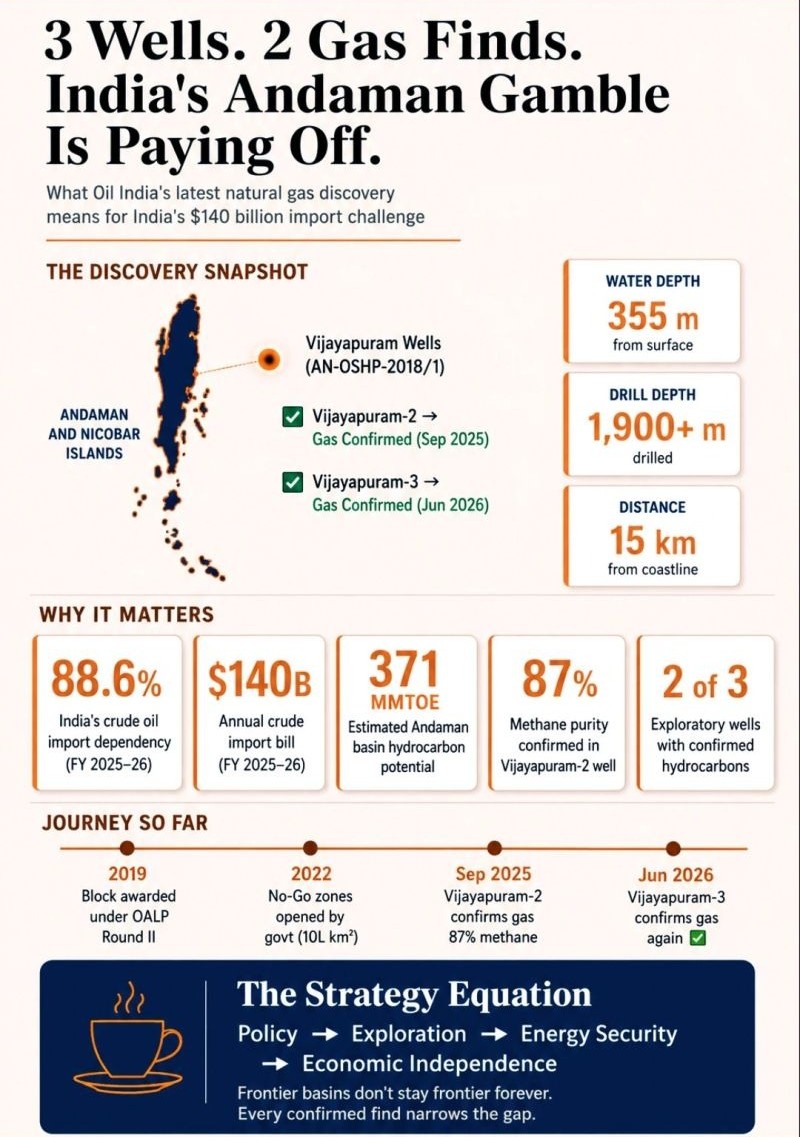
Oil India Limited (OIL) struck natural gas at Sri Vijayapuram-3 well. The exploratory well sits around 15 kilometres off the east coast of the Andaman Islands. It was drilled at a water depth of 355 metres.
Initial production testing went deeper, over 1,900 metres into the earth. It reached the Eocene geological formation, a rock layer dating back tens of millions of years. The presence of natural gas was confirmed through continuous flaring. OIL is now conducting gas sampling. The tests will assess the gas’s composition, calorific value, and origin.
Natural gas was discovered in the region earlier also. Sri Vijayapuram-2, the previous well in the same basin, had already confirmed natural gas in September 2025. Two discoveries within a year signal something significant. The Andaman Basin is beginning to look like a serious energy frontier, and that too, near a geopolitically crucial Malacca Strait.
‘Samudra Manthan’ Mission: India’s Deep-Sea Energy Ambition
These discoveries did not happen by accident. They are the result of a deliberate national programme.
Prime Minister Narendra Modi announced the National Deep Water Exploration Mission on Independence Day 2025. He named it ‘Samudra Manthan’. The name is not coincidental. Just as the mythological churning of the ocean yielded hidden treasures, this mission seeks wealth buried deep below Indian waters. The amrit (nectar) here is energy self-reliance.
The mission aims to explore oil and gas reserves deep beneath India’s seas. Expedited execution of the mission signals urgency and intent. A large number of deepwater and ultra-deepwater exploration wells are planned under the mission. These wells will span India’s offshore basins, not just the Andaman Sea, but across the country’s maritime territory.
The Scale of Potential: What the Andaman Basin Could Hold
The numbers are striking. India’s Hydrocarbon Resource Assessment Study (HRAS) estimates hydrocarbon resources of 371 million Metric Tons of Oil Equivalent in the Andaman Basin. That translates to roughly 2.7 billion barrels of combined oil and gas. Minister Puri has put forward a directional estimate of 11.6 billion barrels.
There is more. Geological modelling also points to possible oil deposits. Global interest in the Andaman Basin has been rising. Significant gas discoveries in the South Andaman offshore in Indonesia have already demonstrated geological continuity across the region. What Indonesia found on one side, India may be sitting on from the other.
The Geopolitical Stakes
The Andaman Sea discovery is not just an energy story. It is a strategic one.
The Andaman Sea connects the eastern Indian Ocean with the Pacific Ocean through the Strait of Malacca. This strait is one of the most important waterways on the planet. Nearly a third of global trade and a large share of the world’s oil and gas passes through it. Like the South China Sea, dominance over the Andaman Sea has long been central to great power competition across the Indian and Pacific Oceans.
The Andaman and Nicobar Islands sit at the eastern entrance to the Malacca Strait. They allow India to monitor and, if necessary, control this critical chokepoint. Analysts have called the islands India’s ‘unsinkable aircraft carrier’. Whoever controls the Andaman basin, the argument goes, controls the Malacca Strait.
China is watching. Over the past decade, Beijing has steadily expanded its naval presence in the Indian Ocean. It has deployed warships, built relationships with neighbouring countries, and established access facilities across the region. This expansion has reached the Andaman Sea and the Bay of Bengal.
India’s Act East Policy has long used the Andaman and Nicobar Islands as a strategic anchor in Southeast Asia. By actively exploring and asserting resource rights in the Andaman Basin, India sends a clear message. It intends to be the dominant power in these waters – economically and militarily.
The ‘Samudra Manthan’ Mission, therefore, is as much a geopolitical statement as it is an energy programme. Drilling in the Andaman Sea is India planting its flag beneath the ocean floor.
Why It Matters: The Andamans as a New Gas Province
India’s energy import bill is enormous. In 2024, India imported approximately $14.98 billion worth of natural gas, around 27.8 million metric tonnes. Most of it came as liquefied natural gas (LNG). Qatar was the largest supplier.
This dependence is a vulnerability. Any disruption in global supply chains – whether from conflict, sanctions, or price spikes – hits India hard. Domestic gas production has the potential to change that equation.
If appraisal confirms commercial viability, the Andaman Offshore Basin could become a new gas province for India. It would add to domestic supply and reduce the import burden. The economic and strategic benefits of that shift are enormous.
Global Partnerships and the Road Ahead
Deep-water drilling is not easy. It requires cutting-edge technology and vast experience. India knows this.
OIL will collaborate with global deepwater experts including Petrobras, TotalEnergies, BP, Shell, and ExxonMobil. These partnerships will be critical as India scales up drilling and moves from discovery to appraisal and eventually production.
The next steps are clear: appraisal drilling, commercial viability assessment, and infrastructure planning. From the first flaring of gas to commercial supply, such projects take considerable time. But confirming reserves is the essential first step. Once a resource map is ready, a coordinated vision for energy self-reliance can follow.
India Making Up for Lost Time
India has been here before and missed the moment. Since Digboi, the country’s first oil refinery commissioned in Assam in 1901, institutions like ONGC and OIL were established. Discoveries were made. There were peaks in crude oil production and gas finds. But self-reliance never became a sustained national priority. Import bills kept rising. The energy potential beneath Indian soil and sea remained largely untapped.
A course correction began in the late 1990s. The New Exploration Licensing Policy (NELP) of 1997–98 opened the sector to private and public players on equal terms. Exploratory blocks increased dramatically. Then came the Open Acreage Licensing Policy (OALP) in 2016, under the Hydrocarbon Exploration and Licensing Policy (HELP). It was designed to attract foreign players and expand India’s exploration footprint. Deep-sea exploration is the next logical step.
But, decades of opportunity were lost. India is now trying to recover that ground, as fast as it can.
The Amrit of Energy Sovereignty
In ancient India, the ‘Samudra Manthan’ did not yield its treasures easily. It required effort, perseverance, and a long churn. India’s modern version is no different.
The discovery at Sri Vijayapuram-3 is a beginning, not a destination. But it is a meaningful one. It represents a nation taking its offshore resources seriously, perhaps for the first time with the urgency the challenge demands.
The discovery is being framed as a significant milestone in India’s energy journey through ‘Amrit Kaal’, the era of self-reliance and national renewal that PM Modi has spoken of repeatedly. If the Andaman Basin delivers on its promise, it could reshape India’s energy balance, strengthen its geopolitical standing in the Indo-Pacific, and power its economic growth for decades.
The ocean is being churned. The amrit may yet emerge.

No comments yet. Be the first to share your thoughts!