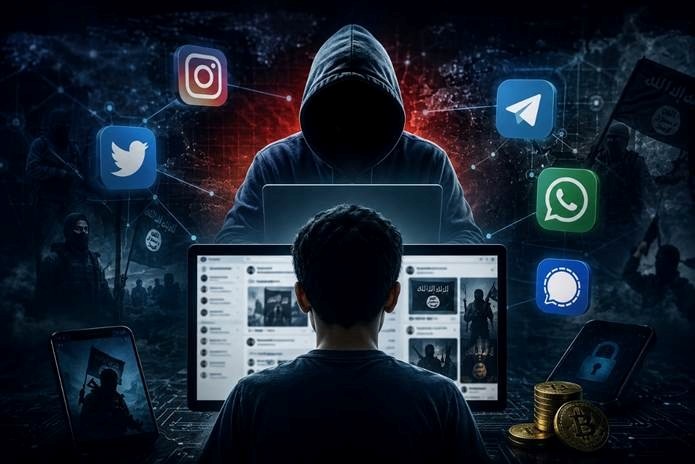
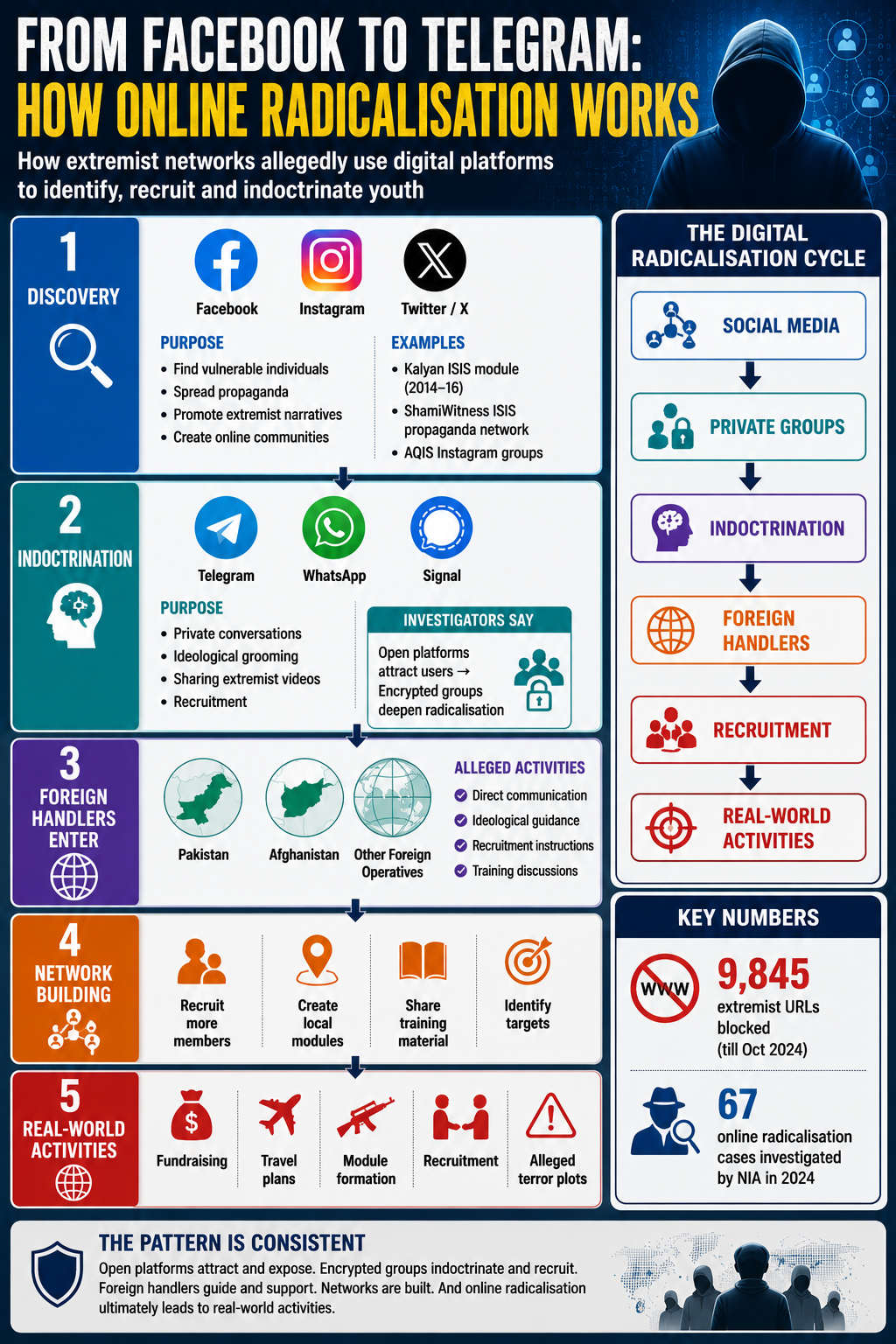
In case of online radicalisation, the pattern identified by investigators is consistent. Social media platforms serve as the discovery mechanism. Encrypted messaging applications become the indoctrination and coordination space. Digital financial tools provide support. Eventually, online radicalisation spills into the physical world through recruitment, module formation, fundraising, travel attempts or preparations for violence. Let’s take a look at some of the popular platforms used by the extremists.
Facebook: Public visibility, targeted networking
In the early years of ISIS recruitment, Facebook emerged as one of the most important tools used by terror recruiters to identify and influence potential recruits. One of India's earliest and most significant examples was the Kalyan ISIS module from Maharashtra.
Facebook became particularly attractive because it combined public visibility with targeted networking. Recruiters could identify vulnerable individuals through interest pages, religious discussion groups, friend networks, comments and algorithm-driven content recommendations. Private groups and Facebook Messenger then allowed conversations to move from public engagement to more personalised ideological discussions.
Between 2014 and 2016, four young men from Kalyan – Areeb Majeed, Fahad Shaikh, Aman Tandel and Shaheem Tanki – came into contact with ISIS networks through online interactions. Investigators later found that Facebook interactions, online chat rooms and digital intermediaries played a significant role in introducing them to ISIS networks and facilitating their movement toward the organisation. Areeb Majeed eventually travelled to Iraq and joined ISIS before later returning to India, where he was arrested and interrogated.
Twitter and the rise of digital propagandists
Twitter's design made it uniquely suited for mass propaganda. Hashtags enabled content to be inserted into global conversations, retweets allowed messages to spread exponentially. Anonymous accounts could rapidly build audiences without revealing real-world identities. A single propagandist could influence thousands of followers across multiple countries in real time.
At its peak, ‘ShamiWitness’ was regarded as one of the most influential English-language ISIS-supporting accounts in the world. Mehdi Masroor Biswas, the engineer who ran the account, translated Arabic propaganda, amplified ISIS battlefield successes, distributed ideological content and helped expand the group's reach among English-speaking audiences.
The significance of the case lay not in direct recruitment but in demonstrating how a single individual sitting thousands of kilometres away from a conflict zone could become a force multiplier for a global terrorist organisation.
Instagram: Visual Persuasion
Instagram's strength lies in visual persuasion. Reels, Stories, image carousels and short videos allow ideological messages to be packaged in emotionally compelling formats that are easier to consume than lengthy texts. Recommendation algorithms, hashtag discovery and follower networks can quickly expose users to interconnected communities. Direct messages and group chats enable recruiters to continue conversations privately.
The January 2026 AQIS online radicalisation case investigated by the NIA provides one of the clearest examples in this regard.
The investigation revealed that Mohammad Faique of Delhi used his Instagram account and a dedicated Instagram group to circulate extremist literature linked to AQIS and Jaish-e-Mohammed. According to the NIA, he shared content promoting jihad, Ghazwa-e-Hind and violence against sections of society. The agency alleged that he collaborated with other accused individuals to expand the reach of such material and recruit vulnerable youth.
The same investigation found that Shama Parveen of Bengaluru used her social media accounts to propagate AQIS videos and actively participated in extremist online groups. Investigators alleged that she maintained contact with a Pakistani national named Sumer Ali and regularly exchanged screenshots, extremist material and discussions relating to banned literature and operations.
Telegram and WhatsApp: Extremists turning them into backrooms
If Facebook and Instagram are the shop windows of modern extremism, Telegram and WhatsApp are its backrooms.
Almost every major online radicalisation investigation in India during the past decade contains references to Telegram channels, WhatsApp groups or private encrypted communication networks.
Telegram has become particularly significant because it combines several capabilities within a single ecosystem. Public channels can broadcast content to hundreds of thousands of subscribers. Private channels can restrict access through invitation links. Large groups can host thousands of members. Files, videos, PDFs, magazines, manuals and audio messages can be shared with minimal friction. Administrators can remain anonymous, use multiple identities, deploy bots and rapidly migrate followers to backup channels if accounts are removed.
Recent controversies surrounding the NEET examination paper-leak investigations have also highlighted why Telegram attracts organised illicit networks beyond extremist groups. Investigators and agencies pointed to the platform’s large broadcast channels, anonymity features, mass-forwarding capability, invite-only groups and message-editing functions as factors that allegedly enabled the circulation of leaked exam material and related misinformation. Authorities temporarily restricted Telegram ahead of the NEET re-examination and even sought restrictions on certain platform functions, highlighting concerns about how rapidly information can spread through the platform’s channel ecosystem.
One notable example emerged from Madhya Pradesh in 2026 when the Anti-Terrorism Squad investigators arrested Mohammad Faraz alias Khalid Saifullah in Bhopal. According to investigators, Faraz had allegedly become connected to a Pakistani-operated WhatsApp group that was involved in radicalising and recruiting Indian Muslim youth.
WhatsApp offers a different but equally powerful set of tools. End-to-end encryption, group chats, disappearing messages, voice notes, video calls and community features enable long-term engagement with recruits. Unlike public platforms, WhatsApp allows sustained one-to-one interaction that helps recruiters establish trust and monitor ideological progression over time.
The investigation revealed a network of Telegram and WhatsApp groups involving members from Pakistan, India and other countries. Investigators alleged that these groups circulated extremist videos, jihadi literature, training materials and instructions related to recruitment. Members were allegedly encouraged to recruit others, create local influence networks, identify targets and swear ideological loyalty.
Another example comes from the Kerala-based ISIS propaganda network involving Qasim Sani, also known as Qasim Khurasani. NIA investigations found that he used Telegram, Instagram, Facebook and other digital platforms to disseminate ISIS propaganda, create extremist content and encourage support for the establishment of a ‘Caliphate’.
Lesser-known but potentially bigger threats
Beyond mainstream platforms, extremist networks have also exploited lesser-known apps to spread propaganda and evade scrutiny.
One documented example is Hoop, which was used by Qasim Sani alias Qasim Khurasani in the 2021 Kerala ISIS module to disseminate ISIS propaganda, create and circulate extremist magazine content, and radicalise youth for potential terror activities.
Many such applications are attractive because they provide a combination of encryption, anonymous registration, minimal moderation, self-destructing messages and smaller user bases that attract less public scrutiny.
Other encrypted platforms such as Signal have surfaced in ISIS-linked investigations as secure communication tools. Signal’s disappearing messages, sealed-sender architecture and minimal metadata collection make it particularly appealing to clandestine actors.
Viber has appeared in broader jihadist communication ecosystems because of its encrypted messaging and cross-border accessibility.
During crackdowns on major platforms, extremists have also migrated to alternatives such as Rocket.Chat and TamTam. These platforms allow the creation of private servers, invitation-only communities and independent communication infrastructures that are more resistant to platform-level moderation or takedown efforts.
Cryptocurrency, dark web and digital financing of extremism
Digital radicalisation does not end with propaganda. Investigators increasingly encounter financial networks that support extremist activities.
The Karnataka ISIS case revealed cryptocurrency transfers from foreign handlers to Indian recruits. According to investigators, online handlers used digital assets to move funds while avoiding traditional banking scrutiny.
Cryptocurrencies offer several advantages for illicit networks. Transactions can occur across borders without conventional banking channels, wallets can be created without physical presence, and funds can move rapidly between multiple addresses. While blockchain transactions are often traceable, layering techniques, privacy-focused services and multiple wallet transfers can complicate investigations.
The Agra conversion-racket investigation uncovered additional concerns. Investigators alleged that certain members of the network used cryptocurrency transactions, foreign funding channels and encrypted communication systems. Police claimed that some financial trails led to contacts in the Gaza Strip. The investigation also revealed that several accused allegedly possessed knowledge of dark-web technologies and used coded communications to avoid detection.
Dark-web forums provide hidden marketplaces, anonymous communication channels and access to illicit services that can support recruitment, financing and operational planning while concealing user identities.
Gaming platforms and youth recruitment
For years, concerns about extremist exploitation of gaming ecosystems were largely associated with Western studies and far-right networks. Indian cases historically offered little evidence that mainstream gaming platforms played a major role in Islamist radicalisation.
However, the Agra conversion-racket investigation introduced a new dimension. According to police officials, the network targeted young individuals through social media, online gaming interactions and encrypted communication platforms.
Gaming ecosystems possess several characteristics that security agencies increasingly monitor. Multiplayer games offer voice chat, text messaging, team formation, friend lists and repeated interaction over long periods. Recruiters can identify socially isolated individuals, build trust through shared gameplay and gradually move conversations onto encrypted applications.
The cases discussed so far show that online radicalisation is not merely a technological challenge but a deeply human one, exploiting curiosity, loneliness, grievances, identity and the search for belonging.
What starts as exposure to content on a social media feed can, over time, evolve into ideological conditioning, recruitment and even real-world consequences. As extremist networks become increasingly sophisticated in their use of digital platforms, the battle against radicalisation is no longer confined to the streets or security operations; it is also being fought in phones, chat groups and online communities, making awareness, vigilance and early intervention more important than ever.


No comments yet. Be the first to share your thoughts!